How to Budget When Your Paycheck Changes Every Month
John Boston

Most budgets quietly assume the same amount arrives on the same day, every month. If you freelance, work shifts, run a small business, or get paid by commission, that assumption is the first thing that breaks — and when it breaks, the whole budget feels useless.
The answer is not to try harder at a budget built for a steady salary. It is to build a different kind of budget: one that starts from your worst month, treats good months as a chance to fill a buffer, and gives every bill a clear place in line. Here is how to set that up, step by step.
Start From Your Lowest Month, Not Your Average
The most common mistake with irregular income is budgeting to the average. An average month sounds fair, but in a slow month you will be short — and a budget that only works in good months is not a budget, it is a wish.
Instead, look back at the last six to twelve months of take-home pay and find your lowest month. That number becomes your base budget: the amount your essential spending must fit inside. Rent, food, transport, minimum payments, and insurance come first. Everything else waits for months when there is more.
This can feel gloomy at first, especially if your lowest month was unusually bad. If one month was a true outlier — you were ill, or work stopped entirely — use your second-lowest month instead, and note the exception honestly. The point is a base you can actually live on, not a punishment number.
The Buffer Account Is the Whole Trick
With a steady salary, the paycheck itself is the safety net: next month's pay is already on its way. With irregular income, you need to build that safety net yourself, and it has a simple job — to turn a bumpy income into a steady one.
Open a separate account, or at least a clearly separate pot, and call it your buffer. In every month where you earn more than your base budget, move the extra into the buffer before you spend it. In a slow month, pay yourself your base amount from the buffer, topping up what actually arrived.
Over time, the goal is a buffer that covers one full month of essentials. You do not need to build it in a week. Start with a smaller target — two weeks of essentials is a real win — and let good months do the work. Our guide to how much to keep in an emergency fund, and where to keep it covers the longer-term cushion that sits beyond this buffer; think of the buffer as the first, working layer.

Pay Bills in Priority Order, Every Month
When money is tight, the order you pay things matters as much as the total. A simple order that works for most people:
- Housing and utilities — rent or mortgage, electricity, water, and heating. Losing these costs far more than a late fee elsewhere.
- Food and transport to work — the basics that keep you earning.
- Insurance and minimum debt payments — staying covered and staying current protects you from much bigger bills later.
- Everything else — subscriptions, extras, and non-essential spending, in whatever order matters to you.
Write this order down once, when you are calm. Then, in a slow month, you are not making panicked decisions — you are following a list you already agreed with yourself.
A Worked Example (Illustrative Only)
This example uses round numbers to show the shape of the system. It is not based on real household data, and your income and bills will be different.
Imagine Maya freelances and takes home different amounts each month: $1,800, $2,600, $2,100, and $1,500 over four months. Her lowest month is $1,500, so that becomes her base budget for essentials.
| Month | Take-home pay (illustrative) | Paid into base budget | Moved to buffer |
|---|---|---|---|
| Month 1 | $1,800 | $1,500 | $300 |
| Month 2 | $2,600 | $1,500 | $1,100 |
| Month 3 | $2,100 | $1,500 | $600 |
| Month 4 (slow) | $1,500 | $1,500 | $0 |
After three months, Maya's buffer holds $2,000 — more than one month of essentials. If month 5 brings in only $900, she can still pay herself the full $1,500 base by drawing $600 from the buffer, and no bill has to be skipped. That is the whole point: the buffer absorbs the dip, so the budget does not have to change every month.
Smooth the Costs That Do Not Arrive Monthly
Irregular income is only half the problem. The other half is irregular expenses: car repairs, annual insurance, school costs, holidays, and gifts. A month with both low income and a big bill is where budgets usually collapse.
The fix is the same idea, applied to spending: set a little aside every month for costs you know are coming, even if they are months away. That is exactly what sinking funds for irregular expenses are for — a small monthly amount for each known cost, so the bill arrives pre-funded instead of as a shock.
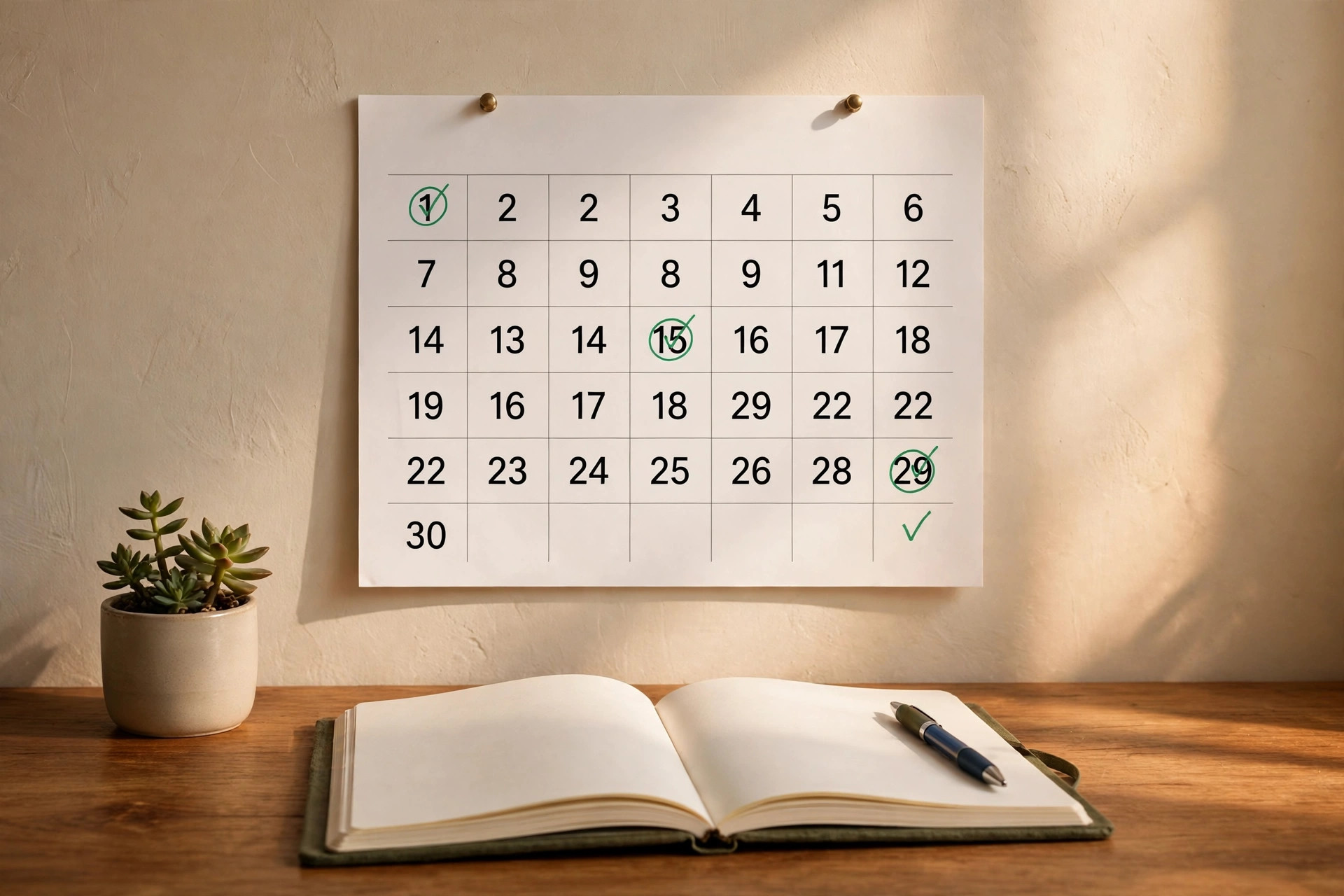
A simple bill calendar helps here too: write every due date on one calendar, including the irregular ones, and check it at the start of each month. Surprises get smaller when you can see them coming.
What to Do in a Really Slow Month
Even with a buffer, a genuinely bad stretch happens. When it does, work the list in order:
- Cut the flexible spending first — eating out, subscriptions, and extras pause before essentials are touched.
- Call before you miss a payment — many providers will move a due date or set up a payment plan if you contact them early. Silence is what turns a late payment into a penalty.
- Use the buffer on purpose — that is what it is for. Refilling it is a job for the next good month, not a reason to feel guilty in a bad one.
- Check for one-off income — a delayed invoice chased, a small job finished, a refund claimed. In a slow month, one payment arriving a week earlier can change the whole picture.
If slow months are becoming the norm rather than the exception, that is useful information, not a failure: it may mean your base budget needs reworking, or that your rates, hours, or client mix need a look. A budget can show you that clearly — which is exactly what it is for.
Frequently Asked Questions
How do I budget if I do not know what I will earn next month?
Budget to your lowest recent month, not your average and not your hope. Pay yourself that base amount each month, and let the buffer absorb the difference in both directions.
How big should my buffer be?
Aim for one month of essential spending as a first goal. Two weeks of essentials is a strong start, and anything above zero already makes a slow month easier than it was.
Should I save for an emergency fund too?
Yes, but in order: the buffer comes first, because it is the tool you will use most often. Once the buffer covers a month of essentials, you can build the longer-term emergency fund on top of it.
What if my income varies a lot from week to week?
Work in monthly totals: add up what arrived in the month, pay yourself your base amount, and move the rest to the buffer. Weekly ups and downs matter less once the month is the unit you plan in.
What counts as an essential expense?
Housing, utilities, food, transport to work, insurance, and minimum debt payments. Everything else can wait in a slow month without putting your home, health, or ability to earn at risk.
Your Irregular-Income Budget Checklist
- Lowest recent month identified — that is your base budget.
- Essential spending listed and fitted inside that base amount.
- A separate buffer account opened.
- A rule set: extra in good months goes to the buffer, slow months draw from it.
- Bills written in priority order, ready for a slow month.
- Irregular costs (car, insurance, annual bills) given their own small monthly amounts.
- A bill calendar checked at the start of each month.
The Bottom Line
Budgeting with irregular income is not about predicting your pay. It is about removing the need to predict it: a base budget you can live on, a buffer that smooths the bumps, and a bill order you decided in advance. Set those three things up once, and a changing paycheck stops feeling like a crisis every month.
For more step-by-step help, explore our Budgeting Guides.
Disclaimer: This article is for general education only and is not financial, legal, or tax advice. Your essentials, bills, and personal circumstances come first — if you are facing financial difficulty, consider a qualified professional or reputable support organisation.
Related guides
- How to Do a No-Spend Week in 2026: A Simple 7-Day Reset That Actually Feels Doable
How to do a no-spend week: set your own rules, stock the kitchen, plan free activities, and use seven days to notice where your money usually slips away.
- How to Save for Moving Costs in 2026: A Simple Plan That Actually Works
How to save for moving costs and a security deposit: list every cost, get real quotes, add a buffer, and save a fixed amount each payday so the big bills do not land all at once.
- How to Negotiate a Lower Bill in 2026: A Calm, Step-by-Step Guide
How to negotiate a lower bill for internet, phone, and insurance: prepare in five minutes, use a calm script, ask the right questions, and check the small print before you agree.
Browse more step-by-step guides in the Budgeting hub.