How to Read a Pay Stub: Deductions & Take-Home Pay
John Boston

Your first pay stub can feel like a puzzle. You were expecting one number, the number on your offer letter, and the amount that lands in your bank account is smaller, with a whole column of lines you did not ask for in between. That gap is normal, and it is not a sign that something has gone wrong. It is just the difference between what you earn on paper and what you actually take home after taxes and other deductions.
This guide walks through a pay stub line by line, in plain language. By the end, you should be able to find the important numbers in under a minute, understand why your take-home pay is lower than your salary, and spot the kinds of mistakes that are worth asking about.
What a pay stub is, and where to find yours
A pay stub, sometimes called a payslip, is the breakdown that comes with each paycheck. It shows what you earned in that pay period, what was taken out, and what was left for you. Think of it as a receipt for your pay: the top usually shows who you are, who your employer is, and the dates covered, and the rest shows the maths behind your paycheck.
Most employers now put pay stubs in an online payroll portal or send them by email, and some still hand out a paper copy with a paper check. If you are not sure where yours lives, check the payroll or human resources section of your employee portal first, and ask your manager or payroll team if you cannot find it. It is worth saving each stub, even if only as a downloaded file, because it is the easiest record to check if a question comes up later.
Gross pay versus net pay: the two numbers that matter most
Gross pay is the total you earned before anything is taken out. If you are salaried, it is usually your annual salary divided by the number of pay periods in the year. If you are paid by the hour, it is your hours multiplied by your hourly rate, plus any overtime or extra pay for that period.
Net pay, also called take-home pay, is what is left after deductions. That is the number you can actually plan around for rent, food, transport, and saving, because it is the money that reaches your account. When people say they earn one amount but feel like they get another, they are usually comparing gross pay on paper with net pay in the bank, and both numbers are correct, they just mean different things.
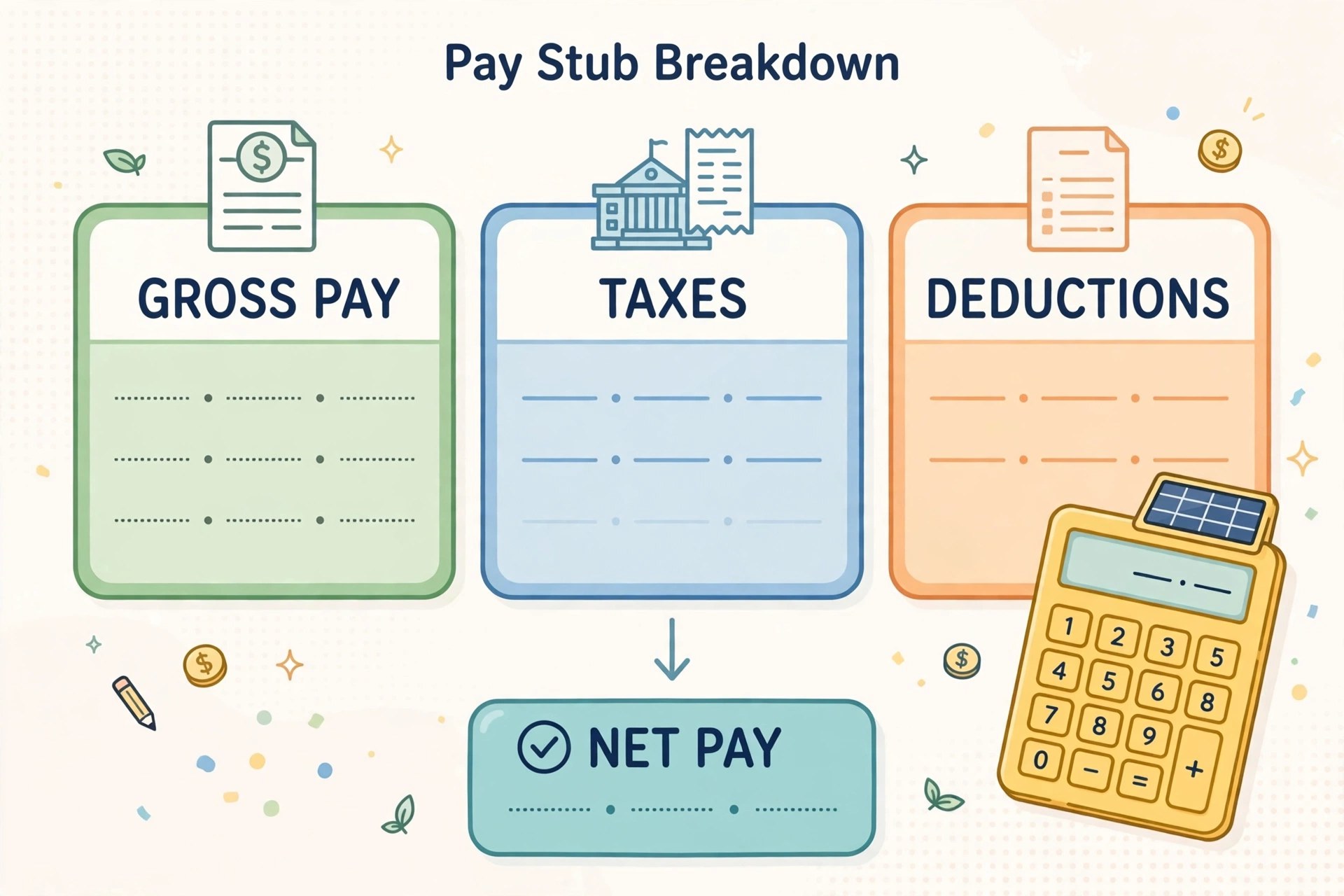
A simple way to check is to look for three lines on your stub: gross pay for this period, total deductions for this period, and net pay. Gross pay minus total deductions should equal net pay. If those three numbers do not add up, that is a good reason to ask payroll to walk through the stub with you.
The main deduction buckets, in plain language
Deductions are usually grouped into a few buckets. The names on your stub may be shortened, so look for words like tax, Social Security, Medicare, retirement, and health, and match them to the list below.
- Federal income tax withholding: an estimate of the federal income tax due on your pay, taken out in advance so you do not face the whole amount later. The amount depends on your earnings and the tax information you gave your employer, and it can change if your pay or that information changes.
- State income tax withholding: a similar advance payment for state income tax, where it applies. Not every state has one, and the amount varies, so do not assume a stub from one state will look like a stub from another.
- Social Security and Medicare: payroll taxes that fund those programs. They are usually shown as separate lines, and they are taken from most wages, which is why they appear even in a short first paycheck.
- Retirement savings: money you chose to put into a workplace retirement plan, if you signed up for one. This is different from tax, because it is saving for your own future, even though it also reduces the amount that lands in your account that week.
- Health insurance: your share of the cost of health coverage through your employer, if you enrolled. The premium is often taken out before tax in a different way from other deductions, but on the stub it simply shows up as a regular deduction from gross pay.
- Other deductions: anything else you agreed to, such as a union fee, a transit pass, or a repayment you authorised. If you see a line here that you do not recognise, keep it in mind for the mistake checks later in this guide.
Once you know what actually lands in your account, you can make a realistic plan for it. A good next step is to read our guide on how to budget your first paycheck, which starts from take-home pay, not from your salary on paper.
Pay period, pay date, hours, overtime, and YTD
Two dates cause a lot of confusion. The pay period is the stretch of work that the paycheck covers, for example two weeks of shifts. The pay date is the day the money is actually paid to you, which is usually a few days after the pay period ends, because payroll needs time to process the hours. If you start a new job halfway through a period, your first paycheck may cover only the days you actually worked, which is why it can look smaller than a full paycheck.
Hours and rate are worth a second look if you are paid by the hour. Regular hours are your normal scheduled hours, and overtime is extra time worked beyond the usual threshold set by your employer or by law, often paid at a higher rate. Your stub should show both the hours and the rate, so you can check them against your own record of shifts, a roster, or a timesheet.
YTD stands for year to date. It is the running total from the start of the calendar year up to and including this paycheck, for gross pay, for each deduction, and for net pay. YTD is useful because it lets you see the bigger picture: one paycheck can look odd on its own, but a YTD total that does not move, or that jumps in a strange way, can point to a missing period or a repeated deduction.
A simple worked example, with round numbers
The example below is illustrative only. It is not a real persons pay, and the deduction amounts are chosen to make the maths easy to follow, not to show what any particular worker would pay. Use it to practise the check: gross pay minus total deductions equals net pay.
| Line | Illustrative amount |
|---|---|
| Gross pay for the period | $3,000 |
| Federal income tax withholding | $300 |
| State income tax withholding | $150 |
| Social Security and Medicare | $230 |
| Retirement savings | $100 |
| Health insurance | $120 |
| Total deductions | $900 |
| Net pay, or take-home pay | $2,100 |
In this illustrative example, $3,000 minus $900 in deductions leaves $2,100. The point is not the exact split, which will be different for every worker, but the habit: start from gross pay, add up the deductions, and confirm that the result matches the net pay shown on the stub.
How to spot a mistake on your pay stub
Most pay stubs are correct, but mistakes do happen, and they are much easier to fix when you catch them early. Work through this short list each payday, and keep a note of anything that looks off.
- Wrong hours: compare the hours on the stub with your own record. A missed shift, a shift counted twice, or a late timesheet can all change the total.
- Wrong rate: check that your hourly rate, or your salary amount for the period, matches what was agreed when you started, and any raise you were told about.
- Missing overtime: if you worked extra hours, check that they appear, and that they are not all listed at your normal rate when overtime should apply.
- Wrong YTD total: add this periods gross pay to the previous YTD total. The result should match the new YTD total, allowing for any correction in between. A YTD total that stays flat after a payday, or jumps by far more than one paycheck, is worth a question.
- A deduction you did not authorise: look for a new line, a changed amount, or a benefit you did not sign up for. Some changes are normal at the start of a new benefits year, but a deduction you never agreed to should always be queried.
If something looks wrong, start by checking your own records, then contact payroll or human resources with the specific line, the pay period, and the number you expected. Keep a copy of the stub and a note of who you spoke to and when. Most payroll teams would rather fix a small error quickly than discover it months later, and a clear, polite question with the numbers in front of you usually gets the fastest answer.
Knowing your real take-home pay also helps you plan for the costs that do not arrive every month. For those, our guide to sinking funds for irregular expenses shows how to set a little aside each payday, and our guide on how much to keep in an emergency fund, and where to keep it can help you decide on a first cushion.
Your simple payday checklist
Use this list every payday. It takes a few minutes, and it turns a confusing document into a routine you can trust.
- Check the pay period and pay date, and make sure the period matches the work you actually did.
- Check your hours and your rate, including any overtime.
- Check that gross pay minus total deductions equals net pay.
- Scan each deduction line, and flag anything new or unfamiliar.
- Check the YTD totals against your previous stub.
- Save the stub, and note any question for payroll while it is still fresh.
- Plan from net pay, not gross pay, when you set money aside for bills and saving.

For more ideas on turning that plan into a habit, explore the budgeting guides on FundMil, which cover the basics in the same plain language.
Frequently asked questions
Why is my take-home pay lower than my salary?
Because take-home pay is what remains after deductions. Your salary is usually quoted as gross pay, before income tax withholding, Social Security and Medicare, and any retirement or health insurance deductions you signed up for. Budget from net pay, and the gap will stop feeling like a surprise.
What does YTD mean on a pay stub?
YTD means year to date. It is the total for the calendar year so far, including the current paycheck, for gross pay, for each deduction, and for net pay. It helps you check that nothing has been missed or counted twice over the year.
What should I do if my hours look wrong?
Compare the hours on the stub with your own record of shifts, then contact payroll or human resources with the pay period, the hours shown, and the hours you believe are correct. Keep the stub and any roster or timesheet you have, so the question can be checked quickly.
Do I need to keep my pay stubs?
Yes, at least for a while. They are useful for checking tax documents, proving income, and resolving questions about hours or deductions. A simple folder, digital or paper, with one stub per payday is usually enough, and you can keep the most recent year close at hand.
The bottom line
Reading a pay stub is mostly about finding three numbers and checking that they agree: gross pay, total deductions, and net pay. Once you can do that, the rest of the stub becomes much less intimidating, and you can spot a wrong hour, a missing overtime line, or an unfamiliar deduction before it becomes a bigger problem. Start with net pay when you plan, save the stub, and ask payroll when a line does not make sense.
Disclaimer: This article is for general education only and is not financial, legal, or tax advice. If you need advice about your own pay, taxes, or benefits, speak to a qualified professional or to your payroll or human resources team.
Related guides
- How to Budget With Irregular Income: A Calm Plan for Paychecks That Change
Learn how to budget with irregular income: base your plan on your lowest month, build a buffer in good months, and pay bills in priority order so a slow month stays calm.
- How to Do a No-Spend Week in 2026: A Simple 7-Day Reset That Actually Feels Doable
How to do a no-spend week: set your own rules, stock the kitchen, plan free activities, and use seven days to notice where your money usually slips away.
- How to Save for Moving Costs in 2026: A Simple Plan That Actually Works
How to save for moving costs and a security deposit: list every cost, get real quotes, add a buffer, and save a fixed amount each payday so the big bills do not land all at once.
See what a paycheck looks like after federal withholding and FICA with the free paycheck calculator.
Browse more step-by-step guides in the Budgeting hub.